
Discover
Pequena África: Rio's Little Africa
The port district where samba, Carnival and Afro-Brazilian identity were forged, and nearly buried.
Pequena África, Little Africa, is the name for the historic heart of Rio's Afro-Brazilian community: the port-adjacent neighborhoods of Saúde, Gamboa and Santo Cristo. The name itself was coined in the early 20th century by Heitor dos Prazeres, a samba composer and painter, to describe the concentration of Black culture and community around this stretch of the port, in deliberate contrast to the more Europeanized city center nearby. After abolition in 1888, freed and formerly enslaved people, many arriving from Bahia, settled here to work the docks, and in doing so built much of what became modern Brazilian culture: samba, Carnival's street parades, and the preservation of Afro-Brazilian religions like Candomblé all trace directly back to this stretch of the city. Today it's often described as a place of sensitive memory, an open-air museum whose most important sites sat buried and unmarked for most of the 20th century.
Cais do Valongo: Where It Begins
Cais do Valongo, the Valongo Wharf, is the honest starting point for understanding this history. Between 1774 and 1831, somewhere between 500,000 and one million enslaved Africans were landed here, making it the single largest point of arrival for enslaved people anywhere in the history of the Americas. In 1843, the wharf was deliberately buried under a new landing built for the arrival of Princess Teresa Cristina of the Two Sicilies, and it stayed hidden under layers of later construction and asphalt for more than a century and a half, rediscovered only in 2011 during Porto Maravilha's redevelopment works. It's now a UNESCO World Heritage Site, and walking across its original stones is a genuinely different experience from most historical markers in Rio: this is unrestored, excavated ground, not a monument built to represent it.
The Hanging Garden That Tried to Hide It
A short walk away sits the Jardim Suspenso do Valongo, the Hanging Garden of Valongo, built in 1906 under Mayor Pereira Passos's sweeping renovation of the city center. The garden wasn't an innocent beautification project: it was built directly over the old slave market specifically to erase its memory, part of a broader effort at the time to remodel Rio's image away from its past. The irony is that the garden itself has since become a place to confront that history rather than bury it. It now houses the Centro Cultural da Pequena África, with a permanent exhibition of objects, cutlery, jars, personal items, excavated during the port's redevelopment.
Largo da Prainha and Mercedes Baptista
Largo de São Francisco da Prainha, a colonial-era square nearby, is anchored today by a statue of Mercedes Baptista, unveiled in 2016. Baptista became the first Black dancer admitted to the corps de ballet of Rio's Theatro Municipal in 1948, and went on to create Brazil's Afro-Brazilian ballet vocabulary, drawing directly from Candomblé's terreiros, and to choreograph for the Salgueiro samba school. The square itself, ringed by colonial houses and casual bars, is a good stop for a coffee or a plate of Bahian food before continuing on.
Pedra do Sal: Where Samba Took Its Modern Form
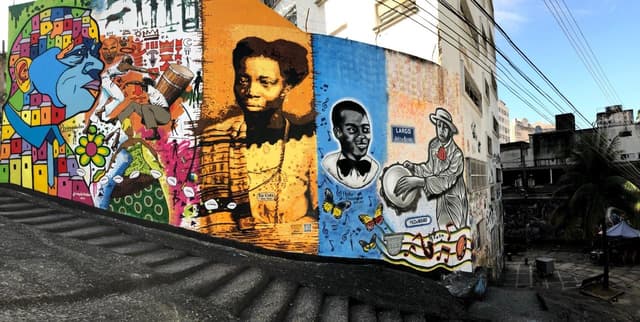
Pedra do Sal, a natural rock outcrop where salt was once unloaded from ships, is where samba took shape as a defined genre in the early 20th century, in gatherings led by figures like Tia Ciata, Donga and Pixinguinha. It was also the site of an old quilombo community, and a portrait of Zumbi dos Palmares, the most significant leader of Brazilian resistance to slavery, has stood painted on a wall here for years, alongside other graffiti referencing Candomblé and the neighborhood's roots. The rock has held official cultural heritage protection since 1984. Time a visit for a Monday evening if you can: an informal, free samba circle still gathers here, a direct continuation of the same tradition, not a staged recreation of it.
Going Deeper: Two Smaller Museums
Two smaller institutions round out the picture for anyone with extra time. The Instituto de Pesquisa e Memória Pretos Novos sits over a mass grave discovered by accident in 1996, during a family's home renovation, now estimated to hold the remains of 20,000 to 30,000 enslaved Africans who died shortly after arrival, making it the largest known slave cemetery site in the Americas. MUHCAB, the Museu de História e Cultura Afro-Brasileira, nearby, covers the wider arc of Afro-Brazilian history and culture. Neither is a large stop, but both add real weight to a walk that can otherwise stay at the level of scenery.
Practical Notes
All of these sites sit within a comfortable walking radius of each other and of the Boulevard Olímpico street art, so the two combine naturally into a single half-day in the port district. See our companion guide, Street Art in Rio, for that route. Go in daylight; this is a quiet, largely residential area outside of event days, and it's better appreciated slowly than rushed. Local guides specializing in Afro-Brazilian history run walking tours through the area and are worth considering if you want the oral history and context that a plaque alone won't give you.
Main sources: RioOnWatch; UNESCO World Heritage documentation on Valongo Wharf; Instituto Pretos Novos; Riotur; Wikipedia (Hanging Garden of Valongo, Mercedes Baptista, Heitor dos Prazeres); Diário do Rio de Janeiro; Geledés.