
Life in Rio
Rio de Janeiro: A City That Never Really Stops
There's no off-season here, just different rhythms, for tourists and for cariocas, all year round.
There's a particular myth about Rio de Janeiro that's worth clearing up straight away: that it's a city built for a single, glorious week, Carnival, and fairly quiet the rest of the time. Nothing could be further from the truth. Spend any real stretch of time here, whether you're a visitor working through a two-week itinerary or a resident who's lived a few blocks from Ipanema beach for a decade, and you start to notice that Rio simply doesn't have an off-season, in the way a lot of famous destinations do. It has rhythms instead, a different one for every day of the week, every season, and every corner of the city, and once you learn to read them, you realize the "attractions" that make it onto postcards are really just the loudest notes in a much longer, richer piece of music that plays all year long.
A City Built Around Its Calendar
Ask a carioca, as locals call themselves, what there is to do in Rio, and you'll rarely get a short answer, because the honest one depends entirely on what week it is. January and February belong to summer, heat, and the long build-up to Carnival, when rehearsals at the samba schools' quadras start pulling in crowds months before the actual parades. Late February or early March brings Carnival itself, arguably the most intense civic celebration anywhere on the planet. April through June eases into a calmer, cooler rhythm, ideal for hiking the trails around Tijuca Forest or wandering the historic downtown without melting in the sun. July brings school holidays and a burst of family tourism. September through November is when the cultural calendar gets particularly dense, with book fairs, art biennials, and film festivals filling the gaps between beach days. And December closes the loop with the single biggest street party most people will ever attend: the Réveillon on Copacabana beach.
Layer on top of that annual rhythm a weekly one, samba circles that rotate through different neighborhoods every night, Sunday markets that have run uninterrupted since the 1960s, Monday traditions that go back generations, and you start to see why cariocas rarely describe their city as having "things to do" in the tourist-brochure sense. It's more that the city itself has a schedule, and living well in Rio, whether for three days or thirty years, is mostly a matter of learning to move with it.
For Visitors, Endless Layers to Peel Back
If you're coming to Rio as a tourist, the postcard version is real and genuinely worth doing: Christ the Redeemer at sunrise before the crowds arrive, the cable car up Sugarloaf Mountain at golden hour, a full day spent alternating between sand, água de coco, and a dip in the Atlantic at Ipanema or Copacabana. But the city rewards anyone willing to go one layer deeper. The historic downtown, still mid-transformation thanks to the Reviver Centro renewal program, holds architectural treasures like the Theatro Municipal and the gold-leafed interior of the Igreja da Ordem Terceira de São Francisco da Penitência, alongside newly hip pockets like Rua do Senado, voted the coolest street on the planet in 2025 by Time Out magazine, beating out contenders in New York, Tokyo, Osaka and Berlin, on the strength of its mix of samba, secondhand furniture shops, and a new generation of restaurants opening inside 19th-century townhouses.
The dining scene alone has become a legitimate reason to visit: the Michelin Guide arrived in Rio and São Paulo in 2024, awarding its first stars to a wave of Brazilian chefs, and 2025 brought a fresh crop of buzzy openings, from the Argentine-inflected bodegón cooking at Gonza in Jardim Botânico to Ophelia in Ipanema, helmed by a chef known for his charcuterie work. Add in the samba circuits described further on in this collection, the Afro-Brazilian heritage trail through Pequena África and the Cais do Valongo, the surf and hang-gliding culture of São Conrado, and the increasingly cosmopolitan nightlife of once-overlooked favela neighborhoods like Vidigal, and it becomes clear that a week in Rio barely scratches the surface.
For Residents, a City Lived Rather Than Visited
For the people who actually live here, Rio functions less as a checklist of sights and more as an ever-present backdrop to daily life, one that happens to include some of the most beautiful urban landscape on Earth. A carioca's relationship with the beach, for instance, isn't really about tourism at all: it's where people exercise before work, meet friends after it, negotiate business over coconut water, and spend entire Sundays doing very little at all. The free outdoor gyms that line the beachfront promenades, the volleyball and footvolley games that run from dawn until dark, the cycling paths that fill up every weekend when beachfront avenues close to car traffic, none of this is aimed at visitors. It's simply how the city functions.
The same goes for its cultural and musical life. Samba isn't preserved in Rio the way folk traditions sometimes are elsewhere, carefully staged for an audience, it's a living weekly habit, with different neighborhoods hosting their own roda de samba on different nights, patronized largely by locals who've been going for years, sometimes decades. Add to that the constant churn of new restaurants, bars and cultural spaces opening across the city (the last few years alone have brought a genuine boom in the Zona Portuária, the reinvention of once-sleepy streets downtown, and a wave of new beachfront kiosks and lounges from Barra to Leblon), and you get a city that residents describe, without much exaggeration, as impossible to get bored in.
Three Windows Into Rio's Rhythm
The rest of this collection zooms in on three specific expressions of that year-round energy, each worth its own article because each tells a different story about the city.
The first is Réveillon, Rio's New Year's Eve, which turns Copacabana beach into the site of the largest fireworks display and one of the largest public gatherings on the planet, a night that blends European calendar tradition with deep-rooted Afro-Brazilian religious practice in a way that's unlike any other New Year's celebration in the world.
The second is Carnival, which needs no introduction but rewards a closer, more good-humored look, not just at the world-famous samba school parades, but at the wildly inventive, often very funny street blocos that have turned the days leading up to Ash Wednesday into a genuinely democratic citywide party.
And the third is something closer to a field guide: a day-by-day walk through what a typical week actually looks like for someone living a carioca life, from the Monday-night samba circle at Pedra do Sal to the recommended day to head up the hill into Vidigal for sunset, including some of the newer habits and hangouts that have taken hold since 2023, because Rio's calendar, for all its deep traditions, keeps adding new verses every year.
Main sources: Time Out Rio de Janeiro (Rua do Senado ranking and neighborhood coverage, 2025-2026); Michelin Guide Brasil; PanRotas (tourism statistics); Monitor Mercantil; Correio Braziliense; TNH1. Data and articles 2024-2026.
Three windows into Rio's rhythm
Two nights the whole world watches, and one ordinary week that shows what it's actually like to live here.
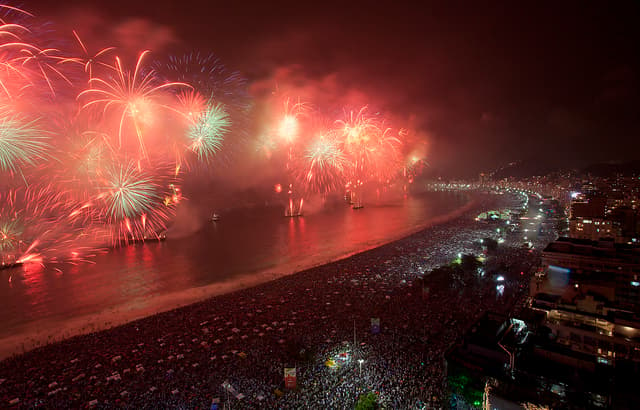
New Year's Eve: Inside the World's Biggest Réveillon
How Copacabana beach became the site of the largest fireworks display on the planet.
Carnival: The Best Excuse on Earth to Be a Little Ridiculous
The samba school parades, and the street blocos that turn the whole city into a party.
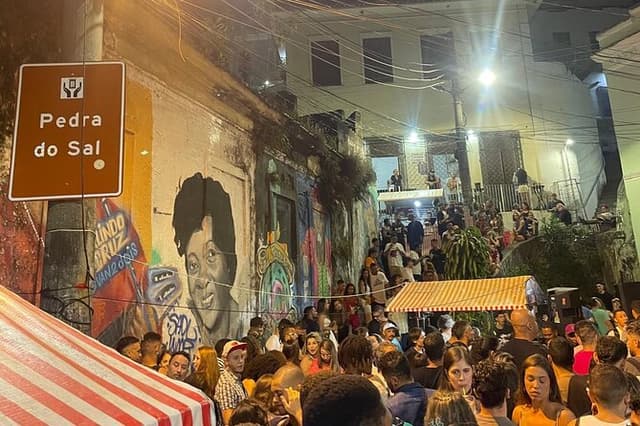
Live Like a Carioca: A Week in Rio, Monday to Sunday
A day-by-day field guide to what a typical carioca week actually looks like.
A Night at the Maracanã: The Independent Traveler's Guide
Tickets, sectors, facial-recognition entry, and how to get in and out safely on your own.