
Discover
Street Art in Rio: A Walking Tour
From a colossal Olympic mural to a staircase tiled by hand for 23 years, a self-guided route through four neighborhoods.
Rio's most interesting open-air gallery isn't in a museum. It runs along a walkable route through four very different neighborhoods, from a colossal mural built for the Olympics to a mosaic staircase tiled by hand over two decades. Here's a self-guided route that connects them, roughly three to four hours at an easy pace, plus the stories behind what you're looking at.
Stop 1: The Port District, Boulevard Olímpico
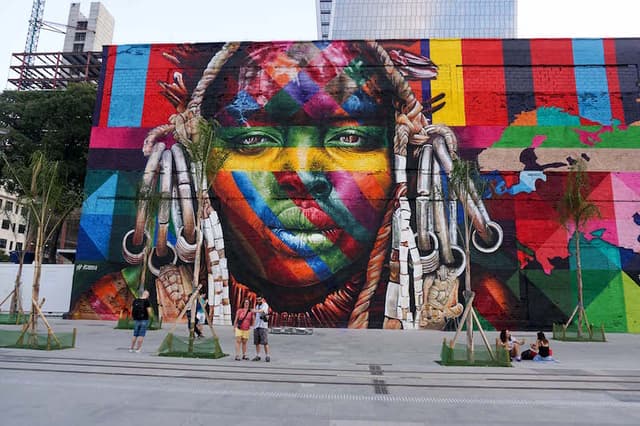
Start in the Porto Maravilha district, reachable by metro to Carioca or Cinelândia and then the VLT tram to Parada dos Navios. The anchor piece here is Etnias (Ethnicities), painted by São Paulo-born muralist Eduardo Kobra in 2016 ahead of the Rio Olympics: five faces, one for each Olympic ring, representing indigenous peoples from five continents, the Huli of Papua New Guinea, the Mursi of Ethiopia, the Kayin of Myanmar, the Sámi of northern Europe, and Brazil's own Tapajós. Depending on the source it covers somewhere between 2,500 and 3,000 square meters of wall, Rio's own tourism board cites 2,500. It's worth knowing, since most travel writing still repeats the claim, that Etnias is no longer the world's largest spray-paint mural. Kobra broke his own 2016 record the following year with an even bigger work at a corporate headquarters in São Paulo. It remains, by a wide margin, the most striking single piece of public art in Rio. Walk the surrounding warehouses along the waterfront for more large-scale murals by other Brazilian and international artists, and stop at Praça Mauá, where the street art shares the square with the Museu do Amanhã's angular architecture.
Stop 2: Pequena África and Pedra do Sal
A short walk from the Boulevard brings you into Saúde, historically known as Pequena África, Little Africa, the neighborhood that formed around communities of enslaved and freed Africans after abolition. Pedra do Sal itself is where samba took shape as a genre in the early 20th century, and its rock outcrop and surrounding walls carry graffiti honoring that history: a portrait of Zumbi dos Palmares, the best-known leader of Brazilian resistance to slavery, has stood on a wall here for years, alongside other work referencing Candomblé and the neighborhood's roots as a quilombo community. If you can time it for a Monday evening, Pedra do Sal hosts one of Rio's most famous informal samba circles, still free, still outdoors, with the graffiti as its backdrop. For the fuller history of this neighborhood, see our companion guide, Pequena África: Rio's Little Africa.
Stop 3: Lapa and the Selarón Steps
Continue toward Lapa, on foot or by VLT, for two very different kinds of street art. The Escadaria Selarón, 215 steps connecting Lapa to Santa Teresa, is technically mosaic rather than paint, more than 2,000 tiles gathered from dozens of countries and cemented in place by hand over 23 years by Chilean-born artist Jorge Selarón, but it belongs in any account of Rio's street art all the same. Nearby, a formerly abandoned alley once called Beco dos Carmelitas has been reborn as Beco do Pantera, an ongoing open-air gallery project led by Rio rapper Shackal, with contributions from established local muralists including Marcelo Ment. The murals here rotate over time and lean heavily on Afro-Brazilian culture and the neighborhood's own history, so what you see on one visit won't be exactly what's there a year later.
Stop 4: Santa Teresa
Finish by climbing into Santa Teresa, on foot or aboard the neighborhood's beloved 1896 tram. This is Rio's most bohemian corner, home to a long-running community of local muralists and galleries built into old colonial houses. Walk Rua Paschoal Carlos Magno and Largo do Guimarães for a mix of large-scale portrait work, nature-themed murals, and openly political pieces, a good example of the local muralist scene at work rather than a single planned installation.
Practical Notes
The port district and Santa Teresa are best done in daylight, mid-morning to early afternoon, when there's enough foot traffic to make the walk comfortable. Stick to the main streets covered here rather than wandering into empty side alleys, especially in Santa Teresa or the port district after dark, and keep your phone in a bag rather than in your hand between photos, the same basic precaution worth taking anywhere in the city. Organized half-day street art tours also run through the usual booking platforms if you'd rather have a local guide handle the route and the history.
Main sources: Riotur; Guinness World Records; Wikipedia (Mural Etnias, Eduardo Kobra); Agência Brasil and Diário do Rio de Janeiro on Beco do Pantera; academic and photo documentation of Pedra do Sal's Zumbi dos Palmares mural; StreetArtNYC interview with Marcelo Ment; Untapped Cities on Rio's street art legalization history.