
Zona Sul
Copacabana
The most recognizable beach on the planet, and the world's biggest New Year's Eve party.
Why It's Beautiful, and Why You Should Visit
Copacabana is quite possibly the most recognizable neighborhood in Rio de Janeiro, and arguably in Brazil as a whole: its crescent-shaped beach, some 4 kilometers long, and the famous black-and-white wave-patterned Portuguese stone promenade are among the defining images of the country. Avenida Atlântica runs the length of the beach from Praça Almirante Júlio de Noronha in Leme all the way to Posto 6, lined with historic hotels, kiosks, cyclists and sunset strollers. Fort Copacabana, which also houses the Army History Museum, offers one of the finest panoramic views over the entire bay. And Copacabana is the stage for the most famous New Year's Eve party on the planet: the 2025-2026 Réveillon on the beach was officially recognized by Guinness World Records as the largest year-end celebration anywhere in the world, drawing cariocas and tourists from every continent.
A Bit of History
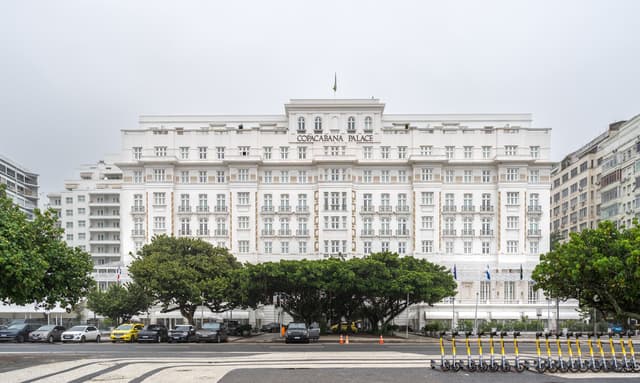
Copacabana's origins go back to the colonial period, when the area was little more than a fishing village on the Guanabara Bay. It officially became a neighborhood on July 6, 1892, on the occasion of the provisional opening of what is now the Túnel Velho, which for the first time connected the area to the rest of the city (it celebrated its 130th anniversary in 2022). Curiously, the name isn't Brazilian at all: it comes from the town of Copacabana in Bolivia, on the shores of Lake Titicaca, tied to the cult of Nossa Senhora de Copacabana, a patron saint brought to Brazil by settlers. It was between the 1920s and the 1950s that the neighborhood exploded as an international glamour destination, epitomized by the iconic Copacabana Palace Hotel, a magnet for celebrities and global elites. The building and population boom of the 1950s and 60s turned it into one of the most densely populated areas in Brazil, blending an Art Deco legacy with an intense, vertical urban life.
The Real Estate Market: 2020 to 2026
Copacabana remains today one of the most expensive and sought-after residential areas of the Zona Sul, though it still trails Ipanema and Leblon in absolute terms. Data on new construction and recent launches puts the average price per square meter for new-build property at around R$29,000 (~$5,686), with peaks of up to R$36,800 (~$7,216) in the most desirable stretches near Arpoador, well above Rio's citywide average of roughly R$14,500 (~$2,843) per square meter in early 2026. On the resale market, values are more modest but still substantial, with transactions around R$13,000 (~$2,549) per square meter for unrenovated period properties.
At the city level, 2025 confirmed a broader cycle of strong growth in the Brazilian real estate market: the FipeZAP Index recorded a national appreciation of 6.52%, the second-highest in eleven years, while Rio de Janeiro as a whole closed the year up around 5%, driven mainly by the upscale neighborhoods of the Zona Sul (where the average price per square meter already exceeds R$11,000 (~$2,157), compared with roughly R$4,100 (~$804) in the Zona Norte). Unlike Ipanema, which jumped 12.5% in 2025, largely on the back of short-term rentals, Copacabana's growth looks more gradual but steady, supported by constant tourist demand, rental income from both short and long stays, and a much larger and more varied housing stock that still includes plenty of period properties awaiting renovation.
Interest From Foreigners and Locals Alike
Copacabana continues to draw an enormous international following thanks to its status as a global pop-culture icon, its dense tourist infrastructure, and prices that remain relatively more accessible than Ipanema or Leblon for anyone looking to invest in the Zona Sul. For cariocas, the neighborhood retains a popular, multigenerational identity, from longtime residents to investors chasing rental income, that sets it apart from the more exclusive profile of its neighboring upscale districts. The combination of globally significant events like the Réveillon, a rich architectural heritage, and an enduring tourist vocation makes Copacabana something of a special case: less purely "luxury" than Ipanema, but with a brand value that Brazil arguably has nothing to match.
Main sources: Estado de Minas; Jornal de Brasília; Correio Braziliense; Agência Brasil/O Povo; Accor/All.com; Apto.vc; Forbes Brasil; Portas.com.br (FipeZAP Index); Jornal O Dia (QuintoAndar data). Articles published between 2025 and January 2026.
Getting Here
Copacabana has three metro stops of its own on Line 1: Cardeal Arcoverde toward Leme, Siqueira Campos in the middle, and Cantagalo at the Ipanema end. From Centro (Cinelândia or Carioca), figure about 11 minutes to Cardeal Arcoverde. Ipanema is one stop away, about 6 minutes, and Botafogo, just north, is a similarly short hop.
Thinking about renting or buying in Copacabana?