
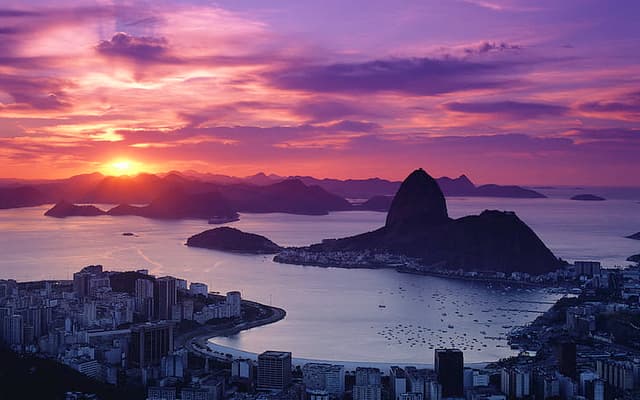
Explore Rio
Rio de Janeiro: The Big Picture
A global comeback story, how Rio went from a lost capital to the center of attention again.
A Short History: From the 1970s to the 2000s
Rio de Janeiro was not always the postcard "Cidade Maravilhosa" that fills millions of searches today for flights, holidays and real estate. For nearly two centuries the city served as Brazil's capital, and it lost that role in 1960 when the seat of government moved to the newly built Brasília, a blow to both its identity and its economy that would take decades to heal. Through the 1970s and 80s, as industrial growth shifted toward São Paulo, Rio settled into a long period of relative decline, marked by urban strain, the unchecked spread of favelas, and an international image increasingly tied to violence, the "cidade partida," the divided city, as it came to be known. The 1990s and early 2000s still brought Rio moments of global visibility, most notably Eco-92, the United Nations Conference on Environment and Development, the largest environmental summit the world had seen up to that point. But those same years were also the decade in which public safety dominated almost every international narrative about the city, holding back both tourism and foreign real estate investment.
The turning point began around the middle of the 2000s. The 2007 Pan American Games were the city's first serious infrastructure bet in decades, followed by the Police Pacification Units (UPP) rolled out from 2008 onward, the 2014 FIFA World Cup (whose final was played at the storied Maracanã), and finally the 2016 Summer Olympics, the first ever hosted in South America. These events reshaped everything from the Galeão airport to the public transport network to entire districts, from Porto Maravilha to what is now Barra Olímpica. But they also left behind heavy public debt and, in the years right after the Games, a fresh bout of economic crisis and a lingering perception of insecurity abroad that slowed the city's tourism and property recovery for a while.
The Explosion of the Last Five Years: Rio Returns to Center Stage
If the years right after 2016 were mostly about catching its breath, the last five years, and especially the last three, from 2023 to 2026, have brought a genuine explosion of visibility and visitor flows to Rio de Janeiro, driven by a rare combination of headline events, deliberate public promotion policy, and urban renewal that finally started to pay off.
Record-Breaking International Tourism
The numbers tell their own story. In 2025, the state of Rio de Janeiro reached a historic high of roughly 2.2 million international tourists, a 43.7% jump over 2024, according to Embratur data cross-checked with the Federal Police. The city alone welcomed 12.5 million visitors, domestic and international combined, generating an estimated economic impact of R$24.5 billion (~$4.8 billion) in the first eleven months of the year. The 2026 summer season is expected to add another R$12.8 billion (~$2.5 billion) to the local economy, 18% more than the previous summer. Argentina, Chile, the United States, Uruguay and France are now the leading source markets for visitors to Rio, a crucial data point for anyone planning travel packages, tourism marketing, or communications aimed at an international audience dreaming of their next holiday in Rio de Janeiro.
The Mega-Concerts That Rewrote Copacabana's History
Nothing captures Rio's return to the global spotlight quite like the "Todo Mundo no Rio" series, free concerts organized by the city government in partnership with the private sector on Copacabana beach:
Madonna (May 2024) closed her "Celebration Tour" with an estimated 1.6 million people on the sand, the largest crowd of her entire career, and enough to beat the record set by the Rolling Stones back in 2006 (1.2 to 1.5 million).
Lady Gaga (May 2025) drew somewhere between 2.1 and 2.5 million people to the beach, an event officially certified by Guinness World Records as the largest free concert ever performed by a female artist.
Shakira (May 2026), touring behind "Las Mujeres Ya No Lloran," pulled in around 2 million people and, according to city estimates, generated roughly R$800 million (about $161 million) for the local economy through hotels, restaurants, transport and retail. City officials have since confirmed that "Todo Mundo no Rio" will remain on Rio's official events calendar at least through 2028.
On top of these sit Copacabana's long-standing New Year's Eve records: the Réveillon has been officially recognized by Guinness World Records as the largest New Year's celebration on the planet, with historic estimates topping two to three million people in its most crowded editions.
Carnival: The Party With No Equal
Carnival remains, by some distance, the single biggest engine of tourism and economic activity in the city. In 2026, Rio's Carnival drew around 8 million revelers across the samba school parades at the Sambódromo, street blocos and popular balls, generating an estimated economic impact of R$5.7-5.9 billion (~$1.12-1.2 billion) for the city alone, with hotel occupancy hovering near 98%. Nationally, Carnival 2026 moved a combined R$18.6 billion (~$3.6 billion) across Brazil, the best February on record since official tracking began in 2011, with more than 65 million participants taking to the streets country-wide.
An Airport Reborn: More Direct Flights to Rio de Janeiro Than Ever
Anyone currently searching for a flight to Rio de Janeiro is also witnessing an unprecedented transformation. In 2025, Galeão airport (RIOgaleão / Tom Jobim) was the fastest-growing hub in all of South America, handling 18 million passengers in total and a record 5.7 million international travelers, an 88.6% increase over the previous 2023 record. Galeão is also becoming an international hub for Gol airlines, with new direct routes announced to New York starting in 2026, alongside Lisbon and Paris, while American Airlines has expanded its direct service to Miami to two daily flights and added a route to Dallas. These new direct connections make Rio de Janeiro more reachable than ever from both North America and Europe, a decisive factor for anyone planning a flight to the Marvelous City.
A Real Estate Market in Full Expansion
The tourism boom is fully mirrored in Rio's real estate market. According to the FipeZAP Index, in 2025 alone the most sought-after neighborhoods of the Zona Sul, such as Ipanema, posted price gains of up to 32%, while fast-transforming areas like Santa Teresa and Catete climbed 33% and 29% respectively over the same period. The municipal Reviver Centro program is also bringing thousands of new residential units back into the historic downtown and the port district (Porto Maravilha), while projects like Ilha Pura, in the newly created Barra Olímpica, show how even the most troubled Olympic legacies can turn into genuine real estate success stories. For anyone following news about the Rio de Janeiro property market, the picture today is that of a city which, after years of post-Olympic stagnation, is once again drawing institutional capital, foreign buyers and fresh investment across nearly every price segment.
Why Rio de Janeiro Has Become an Unmissable Holiday Destination Again
Between iconic beaches like Copacabana and Ipanema, a calendar of musical and cultural events that now rivals the world's great entertainment capitals, an unmatched Carnival, and a steadily expanding roster of direct flights, Rio de Janeiro in 2026 stands out as one of the most dynamic destinations anywhere in the world. The combination of improving perceived safety, fresh infrastructure investment, and an international image relaunched by events capable of generating hundreds of millions of dollars in economic activity on their own is putting the city back at the center of searches, whether from people planning a holiday, weighing a property investment, or simply looking for their next flight to Rio de Janeiro.
Main sources: PanRotas, Tourism Rio de Janeiro and Rio Galeão coverage (2025-2026); Jovem Pan; Monitor Mercantil; Jornal do Brasil; Super Rádio Tupi; O Povo; Poder360; Folha Vitória; InfoMoney; Deccan Herald / international wire coverage of the Shakira concert; IstoÉ Dinheiro; Correio da Manhã; Correio Braziliense; Mercado&Consumo; Travel.com.br; Portas.com.br (FipeZAP Index and Loft data). Data and articles published between 2024 and June 2026.