
Life in Rio
New Year's Eve: Inside the World's Biggest Réveillon
How Copacabana beach became the site of the largest fireworks display on the planet.
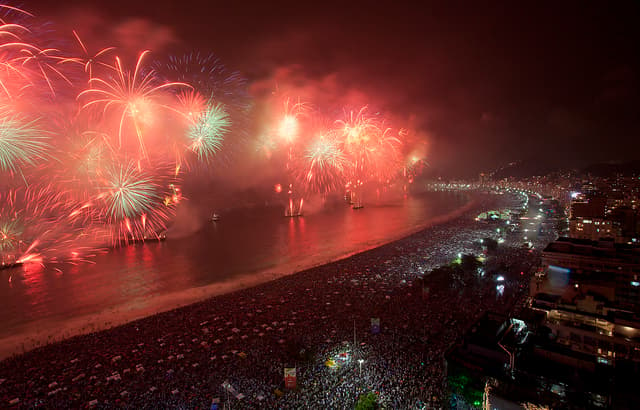
Ask most Brazilians what "Réveillon" means and they'll tell you it's simply New Year's Eve, the word borrowed from the French for "waking up," a nod to the turn from one year into the next, imported into Brazilian Portuguese sometime in the twentieth century along with a handful of other European year-end customs, from eating grapes and pomegranate seeds for luck to avoiding poultry at the table because chickens, as the folk logic goes, scratch backward rather than forward. Ask a carioca, though, and you'll likely get a longer answer, because in Rio de Janeiro the last night of December isn't just an imported party. It's a night that layers that European calendar tradition on top of something much older and more local, a deep current of Afro-Brazilian religious practice, and wraps the whole thing in a genuinely spectacular piece of civic engineering, all playing out on four kilometers of sand in front of two to three million people at once.
Where the Real Story Begins
The white clothes and the fireworks tend to get all the attention, but the tradition actually has two distinct histories that only merged fairly recently. The religious root goes back to the 1930s, when a respected Black spiritual leader, writer and composer named Tancredo da Silva Pinto is credited with popularizing the practice of honoring Iemanjá, the orixá of the sea in Umbanda and Candomblé, queen of the ocean and protector of sailors and fishermen, specifically at the turn of the calendar year. Practitioners would come to the shoreline dressed in white, the color associated with Oxalá, the orixá of peace, and bring offerings meant for Iemanjá herself: flowers, perfumes, soap, small mirrors, sometimes food, often carried out into the water in tiny boats. Tradition holds that if the sea pulls the offering out and under, the wish attached to it will be granted; if it washes back to shore, it won't.
For decades this remained a religious observance rather than a citywide costume. That changed in the 1970s, when practitioners bringing their offerings to Copacabana beach on December 31st began to be noticed by the much larger crowd of ordinary cariocas who simply happened to be there enjoying the summer evening. The visual of the ritual, all that white against the dark water, lit by candles and moonlight, caught on well beyond the religious community that had originated it, and non-practitioners started wearing white themselves, initially just because they found it beautiful, until it hardened into something close to an unwritten dress code for the entire beach. A related custom, jumping seven waves at the stroke of midnight while making a wish or offering thanks with each leap, spread the same way; the number seven ties back to Umbanda cosmology and the seven lines of orixás under which Iemanjá and her fellow spirits are traditionally organized. Some cariocas layer a bit of extra color symbolism on top of the white today, yellow for prosperity, red for love, green for hope, blue for calm, usually as a small accessory rather than a full outfit, since December in Rio is the height of summer and nobody wants to be overdressed in 30-degree heat.
From Beach Ritual to the World's Biggest Party
The fireworks-and-crowds version of Réveillon that now defines the night is a considerably more recent layer, and it escalated fast once it started. Crowd estimates on Copacabana beach were already reaching well into the millions by the early 1990s: roughly 3 million people turned out in 1993 for a joint performance by Jorge Ben Jor and Tim Maia, and the following year, 1994, Rod Stewart drew a crowd Guinness World Records still lists as the largest audience ever for a free concert, somewhere north of 3.5 million people, though the tally likely includes plenty of people who'd simply come for the fireworks rather than the music. That scale never really went away. Recent editions have regularly pulled in 2 to 3 million people onto the beach alone, with satellite celebrations happening simultaneously in Flamengo, Barra da Tijuca, on the island of Paquetá, and at Christ the Redeemer, where a midnight mass marks the turn of the year for those who prefer prayer to pyrotechnics. In December 2025, Rio's Réveillon received a fitting piece of recognition: Guinness World Records officially certified it as the largest New Year's Eve celebration on the planet.
Part of why it matters so much to the city, beyond the spectacle, is economic. The night anchors what's usually the strongest week of the tourism calendar, filling hotels along the entire Zona Sul and pumping a very significant amount of money through restaurants, bars, transport and retail in a matter of hours, a single night that, in scale, rivals entire festival seasons in other cities.
How It Actually Works
The mechanics of the night are, in their own way, as impressive as the party itself. The fireworks, typically somewhere between 15 and 24 tons of them, depending on the year, don't launch from the beach or from buildings, but from a small fleet of barges towed out into the bay by tugboats in the days leading up to the 31st, inspected and cleared by the port authority, the fire department and the civil police before they're allowed to anchor offshore. When midnight arrives, the display usually runs somewhere between 12 and 16 minutes, a tightly choreographed sequence of light synchronized along the whole curve of the beach, visible from balconies and hillsides for miles around. Big-name musical performances on a stage set up on the sand precede and follow the fireworks, turning the night into something closer to a free outdoor festival than a simple countdown.
What There Actually Is To Do
For anyone visiting Rio specifically for New Year's, the most straightforward, and most crowded, option is simply to stake out a spot on Copacabana beach hours in advance, as many Brazilians do, complete with a cooler, a picnic dinner, and the patience to wait out the afternoon heat until the show begins. Hotels along the beachfront, many of them run by international chains, offer a considerably more comfortable version of the same view from rooftop terraces and private parties, usually requiring reservations made well in advance and at a real premium. Those who'd rather skip the crush entirely can catch a nearly identical fireworks spectacle with a fraction of the crowd at one of the satellite celebrations in Barra da Tijuca or Flamengo, or head up to Christ the Redeemer for the midnight mass and a rather more contemplative way of marking the year's turn. And for a distinctly carioca way to participate in the older tradition behind the party, dressing in white and bringing a small offering of white flowers to leave at the shoreline, quietly, respectfully, and ideally sourced as biodegradable material given the environmental toll these rituals can take on the bay, is a way of engaging with the night's original meaning rather than just its more recent spectacle.
Whichever version of the night you choose, the underlying appeal is the same: nowhere else does the turn of the calendar year come wrapped in quite this combination of engineering, century-old spirituality, and sheer collective joy.
What This Actually Costs
Réveillon is, by most measures, the single most expensive week of the year to be in Rio. Industry data ranked the city the second most expensive destination on the planet for New Year's Eve 2025-2026, with minimum available double rooms running around $1,172 for the holiday window, roughly three to four times an average rate earlier in the year. Hotel occupancy across the city reached about 87%, with Copacabana and Leme alone topping 91%.
At the very top end, the Copacabana Palace's own Réveillon gala package started at R$5,445 (~$1,068) per person plus service, for dinner and a front-row view of the fireworks. None of that is necessary to see the show itself: standing on the sand anywhere along Copacabana is free, and it's genuinely the same fireworks either way. The cost is really a cost of comfort and a guaranteed spot, not of access.
Main sources: NSC Total; Monitor Mercantil ("Réveillon e o mar: a memória cultural de Copacabana," citing Denise Barata's research on Tancredo da Silva Pinto); Correio Braziliense; Folha Vitória; Mercado & Eventos; O Povo; Accor/All.com Réveillon guide. Data and articles 2013-2026.
Also in Life in Rio
Carnival: The Best Excuse on Earth to Be a Little Ridiculous
The samba school parades, and the street blocos that turn the whole city into a party.
Live Like a Carioca: A Week in Rio, Monday to Sunday
A day-by-day field guide to what a typical carioca week actually looks like.
A Night at the Maracanã: The Independent Traveler's Guide
Tickets, sectors, facial-recognition entry, and how to get in and out safely on your own.