Centro & Historic Rio
Avenida Rio Branco
Rio's Champs-Élysées, the grand avenue that defines downtown.
Why It's Beautiful, and Why You Should Visit
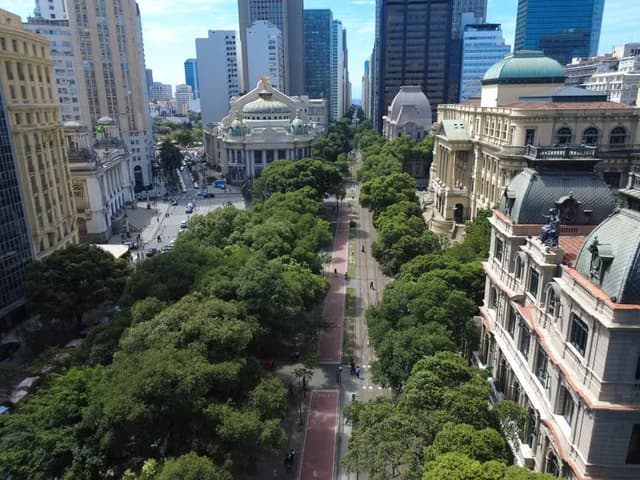
Avenida Rio Branco is one of the most historic and important arteries in Rio de Janeiro, running the length of downtown and connecting the old port area, today's Praça Mauá, all the way to the Glória neighborhood, ending symbolically at Praça Floriano Peixoto, better known as Cinelândia. Along its route stand some of the country's most important public buildings, including the Theatro Municipal, the Museu Nacional de Belas Artes and the Biblioteca Nacional, making it a genuine monumental corridor of carioca Belle Époque architecture, one still very much worth walking today as a piece of living architectural and historical heritage.
A Bit of History
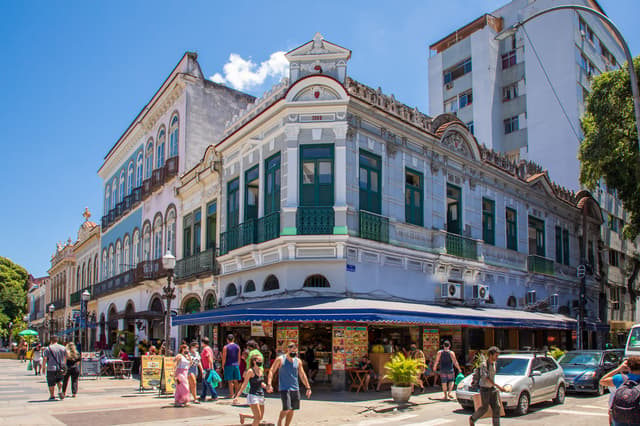
Born as Avenida Central during the sweeping urban reform led by Mayor Francisco Pereira Passos starting in 1904, a program of demolition and modernization inspired by Parisian and European models, the avenue was renamed Avenida Rio Branco in 1912, in honor of the Barão do Rio Branco, Brazil's storied foreign minister. Over the following decades it became the financial, institutional and cultural center of the capital (Rio remained the federal capital until 1960), gradually replacing what little colonial character survived with eclectic, and later modernist, architecture.
The Real Estate Market: 2020 to 2026
Avenida Rio Branco today stands as one of the clearest, most tangible symbols of the transformation currently under way in downtown Rio, thanks to the municipal Reviver Centro program (Complementary Law 229/2021), which offers tax incentives for converting vacant office buildings into residential units. The most striking example: in December 2025 the city issued a permit for the conversion of the building at Avenida Rio Branco 174, which will bring 1,080 new residential units and eight commercial ones, one of the largest retrofit projects ever authorized under the program, totaling over 110,000 square meters of built area once a twin project on Rua Teixeira de Freitas, in Lapa, is included. Between July 2021 and December 2025, Reviver Centro authorized thousands of new residential units across the whole downtown area, against a backdrop of heavy office vacancy and rising demand for well-located housing: as one real estate industry executive summed it up, downtown Rio is living through "an opportune moment," with a huge stock of vacant offices meeting growing demand for well-positioned residential space.
Interest From Foreigners and Locals Alike
The redevelopment under way along Avenida Rio Branco and across downtown mostly involves institutional investors and Brazilian real estate funds, drawn by Reviver Centro's tax incentives and by entry prices far lower than the Zona Sul. For cariocas, these newly converted apartments in historic buildings, often compact 25-to-40-square-meter units aimed at the middle class, represent a chance to live in one of the city's most central, best-connected areas at prices that remain accessible. Foreign interest is still fairly modest compared with Ipanema or Copacabana, but it's growing as downtown reasserts itself as a cultural and residential hub, not just a business district.
Main sources: GuiaDaSemana; City of Rio de Janeiro, Monthly Monitoring Reports of the Reviver Centro Program (April, May, July, December 2025); BandNews FM Rio; Portas.com.br (retrofit of the Lúcio Costa building); ZapImóveis. Data and articles 2025-2026.
Getting Here
The avenue is served by both the Cinelândia and Carioca metro stations along its length, plus the VLT running its full length toward Praça Mauá, making it one of the best-connected corridors in the city, whichever direction you're headed.
Thinking about renting or buying in Avenida Rio Branco?