Centro & Historic Rio
Carioca (Largo da Carioca)
The old civic heart of Rio, where colonial churches meet the modern downtown grid.
Why It's Beautiful, and Why You Should Visit
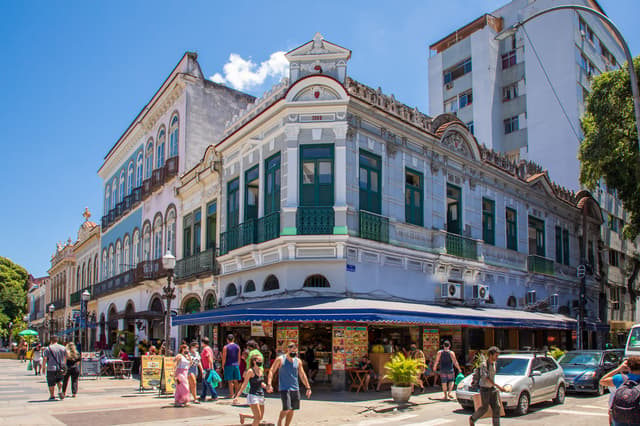
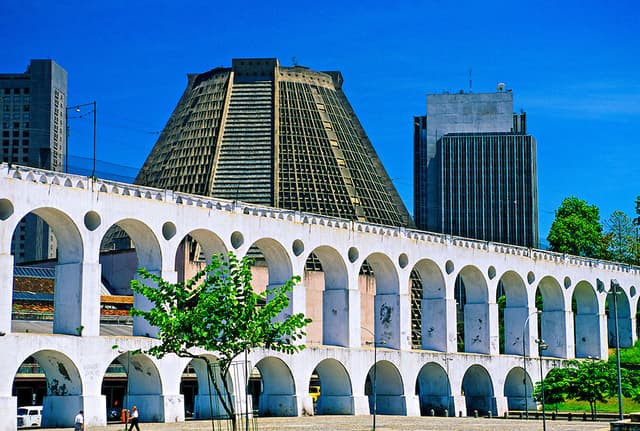
Largo da Carioca is widely regarded as the true "heart of downtown" Rio de Janeiro: a large, constantly bustling public square dominated by the Convento de Santo Antônio, perched atop a small hill. It's here that the city's sharpest contrast plays out, uninspired modern skyscrapers, including the headquarters of Petrobras, the largest company in the Southern Hemisphere, standing just steps away from some of Brazil's most important Baroque religious buildings, such as the nearby Igreja da Ordem Terceira de São Francisco da Penitência, its interior entirely covered in gold leaf. The square's very name is the origin of the word "carioca," now used to describe every resident of Rio.
A Bit of History
Franciscan friars arrived in Rio in 1607 and laid the first stone of the Convento de Santo Antônio the following year, in June 1608, finishing the building, in Portuguese colonial style, in 1620. At its foot once lay a small lagoon, the Lagoa de Santo Antônio, later drained to make room for the square. In 1723 the city's first great public fountain, a chafariz, was inaugurated here, fed by the waters of the Rio Carioca and nicknamed by locals the "Chafariz da Carioca", which is how the square got its final name, replacing the earlier Largo de Santo Antônio. The fountain was rebuilt several times over the nineteenth century (its last neoclassical version, designed by the French architect Grandjean de Montigny, had forty spouts) before being demolished in 1926 during a major expansion of the square ordered by Mayor Alaor Prata. The convent, now restored, has lived through centuries of history: it housed the National Archive between 1885 and 1901, and its mausoleum still holds the remains of several members of the Brazilian royal family.
The Real Estate Market: 2020 to 2026
Like Cinelândia, Largo da Carioca is first and foremost an institutional, religious and office hub, with a limited housing market compared with the beach neighborhoods. The area's value lies mainly in commercial and office real estate, starting with the Petrobras tower, and in its protected historical and religious heritage. As elsewhere downtown, the real news of the 2020-2026 period is the Reviver Centro program, which aims to gradually convert vacant or underused office buildings into residential units, opening up, for the first time in decades, real growth prospects for a housing market that had historically been almost nonexistent outside the commercial segment.
Interest From Foreigners and Locals Alike
For cariocas, Largo da Carioca is a place of daily passage, work, offices, transport hubs (it's a major bus and metro interchange), rather than somewhere people choose to live. For foreign tourists, it offers a chance to discover Brazil's colonial and Baroque soul, often paired with visits to Cinelândia and Lapa. Genuine real estate interest here remains largely institutional and commercial for now, but the potential for residential conversion tied to Reviver Centro is starting to draw attention from small investors, both carioca and foreign, interested in restoring historic buildings at the very center of the city.
Main sources: Instituto Moreira Salles / Marc Ferrez Collection; ANPUR, "Morro de Santo Antônio: significado dos limites de um vazio urbano"; UFRJ, interFACES journal (restoration of the Convento de Santo Antônio); ANPUH, conference proceedings on Anthonian devotion; GuiaDaSemana; NomadicNiko; Momondo Discover. Historical and recent data and articles, 2011-2025.
Getting Here
Carioca station is Rio's main interchange, where Line 1 meets Line 2, with a VLT stop alongside it too. From here it's about 9 minutes to Botafogo, 18 minutes to Ipanema, and a short walk or VLT ride to Lapa and the port district.
Thinking about renting or buying in Carioca (Largo da Carioca)?