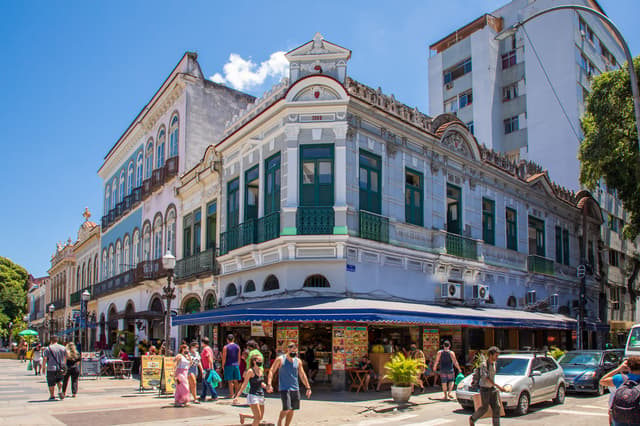
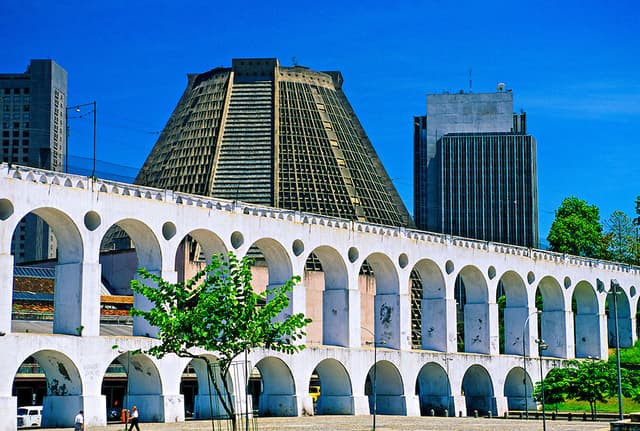
Centro & Historic Rio
Gamboa
Little Africa's port district, rewritten by the Porto Maravilha renewal.
Why It's Beautiful, and Why You Should Visit
Gamboa is home to the single most important historic site in all of Pequena África: the Cais do Valongo, an old port wharf that is today a UNESCO World Heritage Site. Walking its streets means crossing one of the densest sites of memory anywhere in the Americas, but it also means discovering pockets of authentic Afro-carioca culture, such as the Pedra do Sal, a sacred historical and religious monument that has drawn worshippers since the eighteenth century and is now a beloved gathering spot for spontaneous samba circles. The neighborhood, which faces Guanabara Bay near the Morro da Conceição, today brings together archaeology, Afro-Brazilian spirituality and an urban fabric in the middle of a full transformation thanks to the Porto Maravilha regeneration program.
A Bit of History
Built in 1811, the Cais do Valongo operated until 1831 as the main point of arrival and trade for Africans enslaved and brought to the Americas: an estimated one million men, women and children passed through it in those two decades, making it the largest slave-arrival port in the world. The site was only rediscovered in 2011, during archaeological digs carried out as part of the Porto Maravilha project, which unearthed thousands of objects belonging to the Africans who had landed there, including amulets and ritual objects originating from Congo, Angola and Mozambique. In 2013 the Cais do Valongo was granted protected status by IPHAN, Brazil's national heritage institute, and in 2017 UNESCO named it a World Heritage Site, calling it the most important physical evidence associated with the historic arrival of enslaved Africans on the American continent. In September 2025, President Lula signed a law (No. 15.203/2025) further recognizing the site as Afro-Brazilian historical and cultural heritage essential to the formation of the country's national identity.
The Real Estate Market: 2020 to 2026
Like the rest of the port district, Gamboa falls within the Porto Maravilha perimeter and is riding the same real estate acceleration as its neighboring districts, while keeping a more residential, working-class identity than the large new towers going up in Santo Cristo. The average price of properties under construction here has climbed well above the neighborhood's historic levels, driven by proximity to train and metro stations, a park, and a university campus, factors that, according to local real estate operators, are turning Gamboa into one of the up-and-coming destinations for anyone looking to invest at prices still more accessible than the rest of downtown. Across the wider port district, roughly 2,700 new apartments were delivered in 2025 alone, with the population expected to grow from today's 13,000 residents to as many as 45,000 by 2029, according to municipal estimates.
Interest From Foreigners and Locals Alike
For Rio's Afro-carioca community and for movements dedicated to celebrating Black Brazilian culture, Gamboa is a place of the first order of identity: the "Viva Pequena África" initiative, backed by R$73 million (~$14.3 million) in funding, aims precisely to strengthen the historical memory and cultural life of the neighborhood, while a new museum dedicated to the history of Brazil's Black population is also planned, to be housed in a historic building designed by the Black engineer and abolitionist André Rebouças (1838-1898), with an opening expected in 2026. For investors, both carioca and foreign, Gamboa today offers a rare example of a neighborhood where urban regeneration, cultural and historical tourism, and real estate growth are all moving forward hand in hand.
Main sources: ANPR, Guia Pequena África; AlmaPreta.com.br; Jornal do Brasil (Law 15.203/2025); Correio Braziliense; Correio da Manhã (15th anniversary of the Cais do Valongo's rediscovery); Portas.com.br (Porto Maravilha data, 2025-2026). Data and articles 2023-2026.
Getting Here
Like Saúde, Gamboa runs on the VLT rather than the metro, with its own stop a few minutes from Praça Mauá and an easy, walkable or VLT connection to Cinelândia and Carioca in Centro.
Thinking about renting or buying in Gamboa?